A data center commissioning checklist can be used to aid the monitoring and delivery of the activities, tasks, and documentation required to complete an efficient and effective commissioning process of the facility, covering the following:
- Level 0 – Design & Planning
- Level 1 – Factory Testing
- Level 2 – Component Delivery, Installation & Pre-Startup
- Level 3 – Systems Start-Up
- Level 4 – Functional Performance Testing
- Level 5 – Integrated Testing
- Level 6 – Closeout and Turnover / Handover
🔗 The above Levels have been written and explained more in our article DATA CENTER | 5 Levels Of Commissioning Explained to make it easier and understand what should be delivered at each level.
As noted in the article, the general commissioning process should be based on ASHRAE Guideline 0 – and we cover this process here.
🟩 Level 0- Design & Planning
Level 0, managed by the General Contractor and Owners Commissioning Consultant, serves as the initial stage of the project commissioning process, where the primary focus is on laying the foundation for subsequent stages, evaluating, planning, and documenting the necessary information, tasks, and activities for successful commissioning.
It is important to note that while Level 0 primarily focuses on the below tasks, some will continue throughout the project and carry over into subsequent levels.
| Ref | Task / Activity | Description | CxA Responsibility |
|---|---|---|---|
| L0-01 | Prior Project Lessons Learned Review | An evaluation of past projects performance and commissioning outcomes to identify successes, shortcomings, and actionable insights to improve the current project. | Leads the review of historical project lessons learned information, applying valuable lessons learned directly to the formulation of the current Owner's Project Requirements and Commissioning Plan. |
| L0-02 | Write and Issue Owner's Project Requirements [OPR] | A foundational document detailing a project's functional needs, goals, and operational expectations. Its purpose is to guide all design, construction, and commissioning decisions throughout the project lifecycle. | Facilitates workshops, guides the owner in defining operational goals, and formally documents the final OPR for project-wide use. |
| L0-03 | Conduct regular Owner's Project Requirements [OPR] Meetings and issue minutes | Formally records discussions, critical decisions, and assigned action items from OPR workshops. This ensures ongoing stakeholder alignment on project goals and captures the evolution of owner expectations. | Records, reviews, and distributes accurate minutes from OPR workshops to ensure all stakeholders remain perfectly aligned on decisions. |
| L0-04 | Write and Issue Basis of Design Document [BOD] | Records the specific engineering concepts, calculations, and product selections utilised by the design team to satisfy the Owner's Project Requirements and comply with applicable regulatory standards. | Reviews the design team's BOD to definitively verify it accurately reflects and satisfies the requirements outlined in the OPR. |
| L0-05 | Conduct regular Basis of Design [BOD] Meetings and issue minutes | Documents iterative design discussions, alterations, and formal approvals from BOD meetings. This maintains a clear historical record of why specific engineering and design decisions were made. | Attends BOD meetings, reviews minutes for accuracy, and closely tracks any design changes that might negatively impact commissionability and the approved OPR. |
| L0-06 | Issue BMS Specification | The detailed requirements defining the network architecture, hardware components, software capabilities, and integration protocols of the Building Management System. | Reviews requirements detailing network architecture and robust capabilities to verify the Building Management System can be fully and seamlessly integrated and tested. |
| L0-07 | Issue BMS Points List | A comprehensive directory of all hardware and software data point that is monitored, alarmed, or controlled by the Building Management System. | Ensures the list is ready early and reviews to ensure all points required for operations is included and testable. |
| L0-08 | Issue BMS Graphic Document | The approved visual layouts, floorplans, and user interface screens utilized by facility operators to monitor and interact with the Building Management System. | Ensures that the document is available, and approved by the MEP Designer. |
| L0-09 | Issue Controls Specification | The technical standards explicitly defining the hardware components, communication protocols, and performance requirements of the localized mechanical and electrical control systems. | Reviews technical standards to strictly ensure hardware and complex communication protocols of localized control systems are highly commissionable. |
| L0-10 | Issue Sequence of Operation [SOO] Document | A clear, written narrative describing exactly how equipment and systems will function, stage, and react under normal, emergency, and failure conditions, based on the control logics. | Review the written documents to ensure function, stage, and correctly react under all possible conditions, inline with the design and OPR requirements. |
| L0-11 | Issue Electrical Specification | The comprehensive technical document defining the precise design standards, installation methods, and stringent performance requirements for all facility electrical systems. | Ensure has access to document for commissioning tasks and activities. Conducts a review to ensure that any commissioning related items in the document align with the overall project and client expectations. |
| L0-12 | Issue Electrical System Discrimination Study | An analysis ensuring that electrical circuit breakers trip in the correct sequence to successfully isolate specific faults while maintaining power to the rest of the facility. | Ensures that the approved document is available and approved by the project team? |
| L0-13 | Issue Electrical Arc Flash Study | A critical safety assessment calculating the potential explosive energy of an electrical fault to determine the mandatory personal protective equipment (PPE) for workers. | Ensures that the approved document is available and approved by the project team? |
| L0-14 | Issue Arc Flash Sticker Design | The specific visual, textual, and colour requirements for mandatory warning labels detailing the precise arc flash hazards present on specific electrical panels. | Reviews the visual requirements for mandatory warning labels to ensure they accurately detail precise, calculated arc flash hazards inline with design. |
| L0-15 | Issue ELV Specification | The comprehensive requirements for all Extra-Low Voltage systems, encompassing the security, access control, data networks, and critical communications infrastructure. | Reviews requirements for Extra-Low Voltage systems to strictly ensure life-safety security, data, and critical communications infrastructure can be adequately tested, and reviews that any commissioning related items in the document align with the overall project and client expectations. |
| L0-16 | Issue Fire Specification | The design, installation, and operational requirements governing the life-safety fire detection, alarm signalling, and automated suppression systems. | Reviews design and operational requirements to verify life-safety fire systems can be completely and comprehensively tested and integrated. Ensures that any commissioning related items in the document align with the overall project and client expectations. |
| L0-17 | Issue Fire Cause & Effect Matrix | A matrix detailing exactly how all various mechanical, electrical, and security systems must automatically react to specific fire alarm zone triggers to ensure life safety. | Ensure that the document is available and approved by the MEP Designer, review the matrix to ensure all connected systems can be commissioned. |
| L0-18 | Issue Mechanical Specification | The detailed technical requirements governing the precise installation standards and performance metrics of all HVAC, cooling, and mechanical plant equipment. | Ensure has access to document for commissioning tasks and activities. Conducts a review to ensure that any commissioning related items in the document align with the overall project and client expectations. |
| L0-19 | Issue Computational Fluid Dynamics Study [CFD] Data Halls | A digital simulation analyzing airflow patterns and temperature distribution within IT spaces to verify cooling effectiveness and note and hot spots. | Ensure the document is available and then review for any issues. |
| L0-20 | Issue Computational Fluid Dynamics Study [CFD] Buffer Tanks | A digital simulation used to verify proper internal fluid mixing, flow dynamics, and thermal stratification efficiency within large mechanical thermal buffer tanks. | Ensure the document is available,where needed, and then review for any issues. |
| L0-21 | Issue Low Load Strategy Document | A strategic plan detailing how facility systems and equipment will be tested and operate efficiently, safely, and maintain design parameters during periods of minimal occupancy or low operational demand. | Collaborates with the design team to review and establish the strategy, ensuring it aligns with the Owner's Project Requirements and provides clear parameters for low-load functional testing. |
| L0-22 | Issue Plumbing & Drainage Specification | The technical design and testing standards for all domestic water supply, sanitary waste, sump and storm drainage infrastructure. | Ensure has access to document for commissioning tasks and activities. Conducts a review to ensure that any commissioning related items in the document align with the overall project and client expectations. |
| L0-23 | Issue Plant Schedules / Detail Document | Detailed engineering tables comprehensively listing the exact specifications, capacities, physical dimensions, and operational design parameters for all major plant equipment. | Cross-references detailed engineering tables directly with the OPR and installed equipment to ensure capacities and operational design parameters match. |
| L0-24 | Issue Data Hall Cleaning Specification Document | Defines the strict environmental cleanliness standards and precise cleaning procedures required in critical IT spaces during and after commissioning activities to protect sensitive equipment. | Reviews the specification to verify mandated cleaning standards are entirely adequate to protect sensitive equipment during dynamic testing and turnover. |
| L0-25 | Issue Client Specific Cx Document List | A tailored list detailing all specific client commissioning documents that are to be referred to throughout the project. | Consults with the client to properly define and compile the list of documents. |
| L0-26 | Issue Commissioning Team Tasks and Activities Responsibility Matrix | A comprehensive grid explicitly defining the specific roles, tasks, and ownership (e.g., responsible, accountable, supportive) for every project team member across all commissioning activities. | Creates, maintains, and enforces the matrix, ensuring all contractors and stakeholders clearly understand and execute their specific commissioning duties without overlap or omission. |
| L0-27 | Issue Commissionability Review Report [30%] | Identifies initial design issues at the 30% phase, ensuring early integration of commissioning requirements, adequate spatial allowances, and overall testability before the design progresses further. | Conducts the early design review, identifies spatial or testing issues, and issues the formal report outlining required modifications. |
| L0-28 | Issue Electrical Layout / Schematic Drawings [Design Stage] | Full set of the detailed Electrical Layout and Schematic Drawings, used for the early stages of the Commissioning Process and Reviews. | Ensures these drawings are available to complete all Commissioning Tasks and Activities. |
| L0-29 | Issue BMS Layout / Schematic Drawings [Design Stage] | Full set of the detailed BMS Layout and Schematic Drawings used for the early stages of the Commissioning Process and Reviews. | Ensures these drawings are available to complete all Commissioning Tasks and Activities. |
| L0-30 | Issue ELV Layout / Schematic Drawings [Design Stage] | Full set of the detailed ELV Layout and Schematic Drawings used for the early stages of the Commissioning Process and Reviews. | Ensures these drawings are available to complete all Commissioning Tasks and Activities. |
| L0-31 | Issue Fire Layout / Schematic Drawings [Design Stage] | Full set of the detailed Fire and Life Safety Layout and Schematic Drawings used for the early stages of the Commissioning Process and Reviews. | Ensures these drawings are available to complete all Commissioning Tasks and Activities. |
| L0-32 | Issue Mechanical Layout / Schematic Drawings [Design Stage] | Full set of the detailed Mechanical Layout and Schematic Drawings used for the early stages of the Commissioning Process and Reviews. | Ensures these drawings are available to complete all Commissioning Tasks and Activities. |
| L0-33 | Issue Plumbing & Drainage Layout / Schematic Drawings [Design Stage] | Full set of the detailed Plumbing & Drainage Layout and Schematic Drawings used for the early stages of the Commissioning Process and Reviews. | Ensures these drawings are available to complete all Commissioning Tasks and Activities. |
| L0-34 | Issue Commissionability Review Report [60%] | Evaluates 60% design documents for practical testability, physical accessibility, and cross-system integration logic before the construction phase begins, preventing costly late-stage modifications. | Evaluates the 60% design for practical testability and system integration, issuing a report with recommendations to proactively prevent construction delays. |
| L0-35 | Conduct Commissioning Meetings and Issue Minutes | Formal, distributed records capturing the discussions, critical decisions, and explicitly assigned action items from all recurring commissioning coordination and progress meetings. | Chairs coordination meetings, records discussions, formally assigns vital action items, and directly distributes minutes to all stakeholders. |
| L0-36 | Issue Project Risk Register | A continuously updated tracking log identifying potential commissioning risks, evaluating their potential impacts, and assigning specific mitigation strategies to prevent project delays. | Continuously updates the log, actively identifying potential commissioning risks and assigning highly specific mitigation strategies to prevent project delays. |
| L0-37 | Issue Equipment to be Factory Tested Schedule | A continuously tracked list of all major or critical equipment requiring off-site performance verification (FAT) before being approved for shipment to the project site. | Compiles and continuously tracks the list of critical equipment strictly requiring off-site performance verification before site delivery is approved. |
| L0-38 | Issue Drawing List / Status Tracker | A log that monitors the latest revisions, formal approvals, and site distribution of all project design, construction, and as-built drawings. | Gain access to the log, actively monitoring it ensuring the commissioning team is utilizing the latest, officially approved revisions of all project drawings. |
| L0-39 | Issue Material Submission Document List / Tracker | A list tracking the formal review, comments, and approval status of all equipment and material submittals against the project specifications. | Gain access to the log. Track the approval status of equipment submittals and review them specifically for commissionability and strict OPR compliance. |
| L0-40 | Room Readiness Checklist Template | A standardized template outlining the specific architectural, mechanical, and electrical prerequisites that must be completed before a room is deemed ready for equipment installation and testing. | Develops and issues the checklist template to establish clear, verifiable readiness criteria, ensuring all trades understand the exact requirements for space completion before testing begins. |
| L0-41 | First-Of-A-Kind List / Tracker | A centralized tracking document identifying the first installed instance of each equipment type, scheduled for an initial benchmark inspection to establish project quality standards. | Develops and maintains the tracker, collaborates with contractors to identify key equipment for benchmark inspections, and ensures these initial reviews are scheduled effectively. |
| L0-42 | Issue Level 4 Test Scope and Delivery Document | Defines the specific requirements, and detailed execution plan for conducting the functional performance tests on site. | Writes the document and execution plan for actively conducting all functional performance tests. |
| L0-43 | Issue Level 5 Test Scope and Delivery Document | Defines the specific scenarios, simulated failure modes, and criteria required for executing the facility-wide Integrated Systems Test (IST). | Writes the document and execution plan for actively conducting all Integrated Systems Testing. |
| L0-44 | Schedule and Programme for Level 4 & Level 5 Requirements | A detailed timeline explicitly mapping out the execution of dynamic functional performance testing (Level 4) and comprehensive integrated systems testing (Level 5). | Develops, coordinates, and actively manages this testing schedule, ensuring all contractors are aligned on dates, prerequisites, and resource needs for critical testing. |
| L0-45 | Issue List of Seasonal Testing that will be completed after Occupancy and Operations | A schedule for testing facility systems during peak heating, cooling, and intermediate seasons post-occupancy to verify performance across all weather conditions. | Directs the seasonal testing with the operations staff, resolves any identified issues, and recommends the final seasonal testing results to the owner for acceptance. |
| L0-46 | Issue Commissioning Specification | Details the precise technical testing standards, methodologies, and specific contractor responsibilities required during the physical commissioning of systems to ensure compliance with the design intent. | Writes or heavily contributes / obtains to the specifications, defining testing standards, strict methodologies, and exact contractor responsibilities for physical commissioning. |
| L0-47 | Create Cx Document Approval Process Flow | A flow diagram detailing the issuing, review steps, and formal sign-off process required for all commissioning documents submitted throughout the project. | Develops and enforces this workflow, ensuring all stakeholders review and sign off on crucial testing documents in a timely manner. |
| L0-48 | Issue Initial Commissioning Plan | An early-stage strategic roadmap defining the overarching commissioning scope, roles, sequencing, and preliminary testing strategies for the entire project lifecycle. | Develops this early-stage strategic roadmap, carefully defining the overarching scope, roles, sequencing, and preliminary testing approaches for the project. |
| L0-49 | Issue Initial Commissioning Programme | A preliminary master schedule outlining high-level timelines, critical path milestones, and anticipated durations for testing, verification, and final handover activities. | Drafts the preliminary master schedule, meticulously outlining high-level timelines and critical path milestones for all testing and verification activities. |
| L0-50 | Issue Initial Training Programme | An early, high-level outline of the required instructional sessions and knowledge transfer activities needed to fully prepare the facilities team for independent system operation. | Outlines the preliminary training requirements and critical knowledge transfer sessions needed to adequately prepare the facilities team. |
| L0-51 | Issue Commissionability Review Report [90%] | A near-final comprehensive review of 90% design documents to ensure all previous commissioning comments have been successfully incorporated and systems are ready for finalized construction drawings. | Reviews near-final documents to ensure all previous comments were successfully incorporated and systems are fully ready for physical construction. |
| L0-52 | Issue Project Document Management System Guideline | Outlines the standardized procedures for utilizing the centralized software platform to efficiently upload, formally review, track, and approve project documentation among all stakeholders. | Adheres to the established system and ensures all commissioning-related documentation is correctly uploaded, formally reviewed, and actively tracked. |
| L0-53 | Issue BIM Execution Plan Document | Details exactly how Building Information Modeling (BIM) will be implemented, managed, and shared among the project stakeholders to support coordination, clash detection, and eventual facilities management. | Reviews the BIM plan to assure commissioning data requirements, such as vital asset tagging and O&M integration, are properly incorporated, if required. |
| L0-54 | Issue Early 'On' Cooling Requirement Document | A strategic plan outlining the requirements for ensuring that cooling will be avaliable to the areas of the project to allow testing of equipment and systems [for example UPS Rooms] | Creates the plan to ensure the early cooling strategy is viable, safe, and aligns with the overall commissioning schedule without compromising final testing phases. |
| L0-55 | Issue Temporary Load Bank, Equipment and Energisation Plan | A logistical and safety plan detailing exactly how temporary power supplies and artificial heating/cooling loads will be safely deployed and managed during system testing. | Create the logistical plan to ensure temporary power and artificial loads will be safely and effectively deployed during system testing, inline with requirements. |
| L0-56 | Issue Thermal Scanning Method and Location Plan | A document identifying the specific electrical panels, bus bar, critical connections, and mechanical equipment that require infrared thermographic scanning. | Creates the document identifying specific panels and equipment requiring infrared thermographic scanning, inline with project requirements. |
| L0-57 | Issue Gap Analysis of Contractors / Vendors | An assessment report identifying any gaps in contract deliverables [off site, onsite and commissioning] between the contractor team and vendors / suppliers that have been specified or novated by the client. | Conducts or obtains the critical assessment to proactively identify gaps and providing report. |
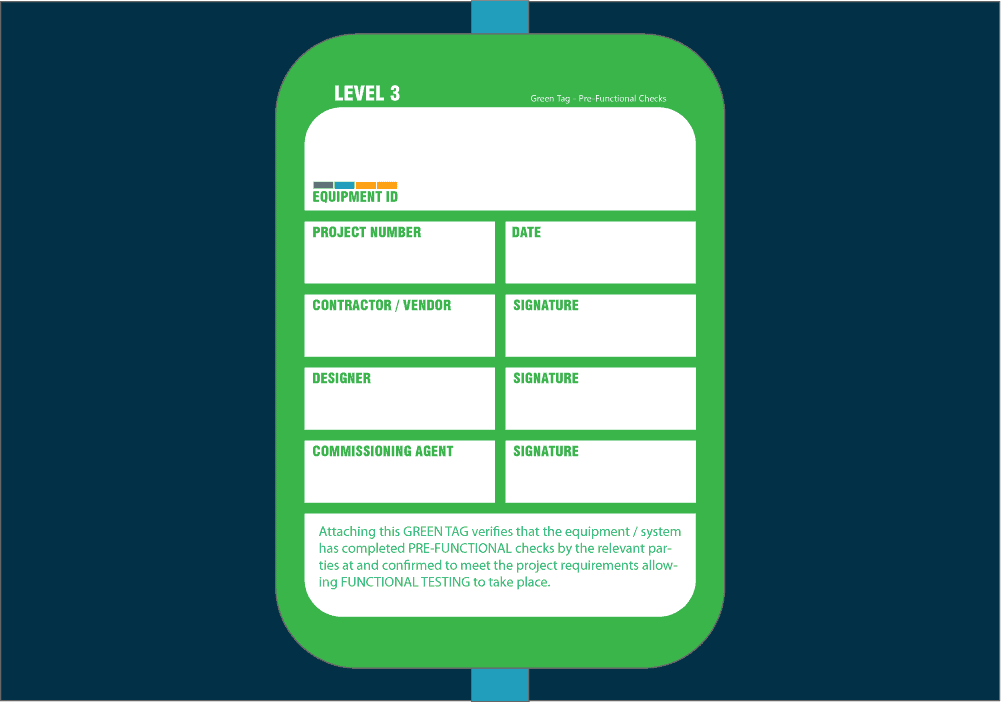
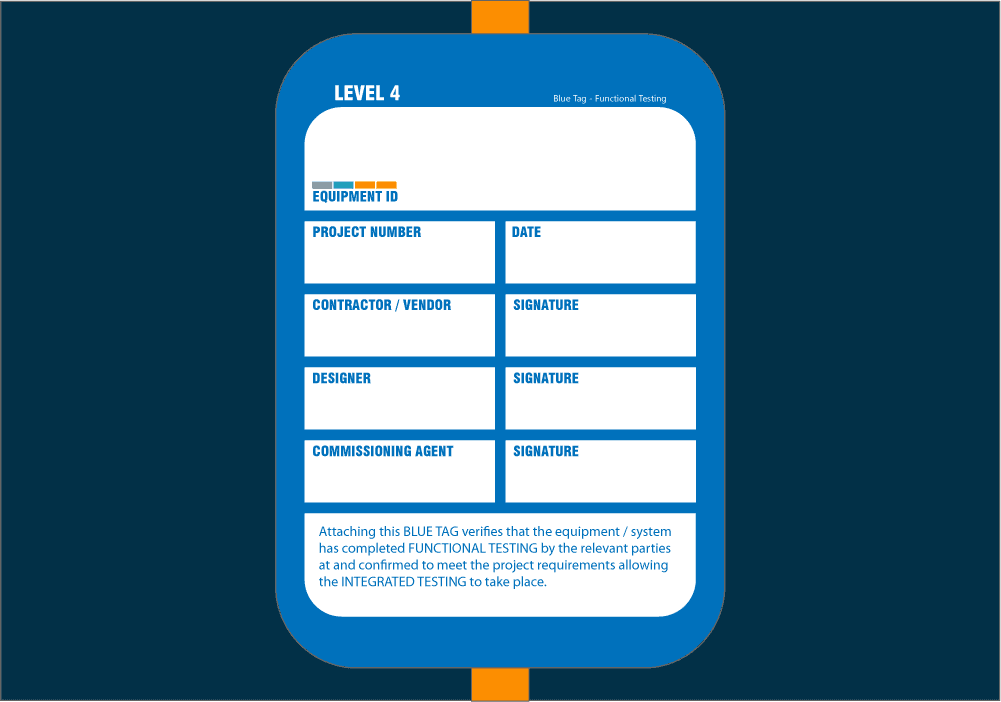
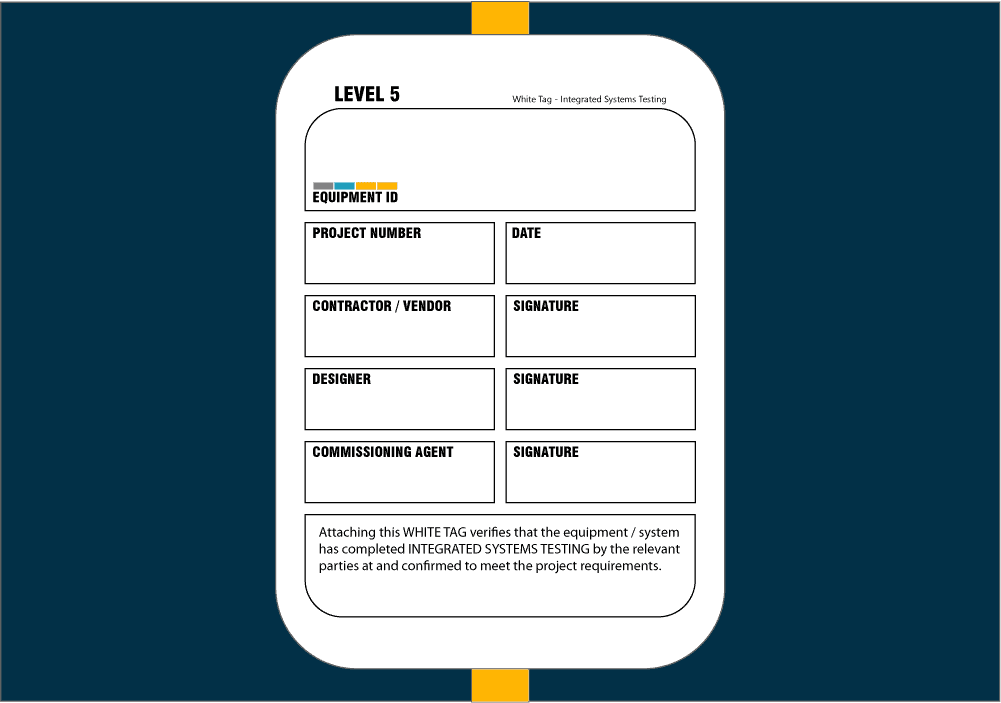
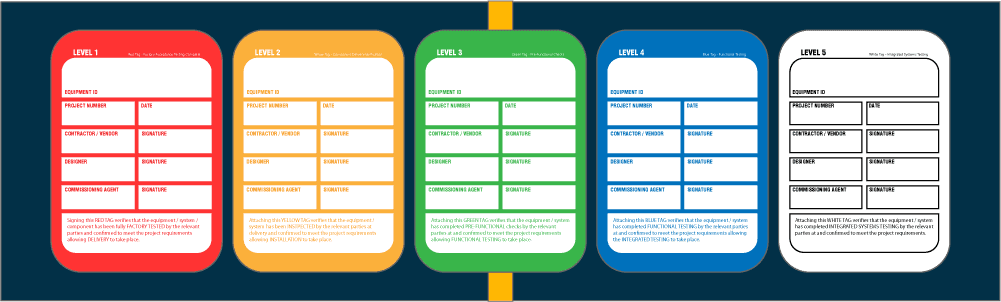
| L0-58 | Issue Tag / Level Sticker Design | The graphic specifications, colour coding, and material requirements for labels used to physically identify equipment and denote its corresponding commissioning completion stage. | Defines the specific graphic specifications and color coding for labels used to physically identify equipment's precise commissioning completion status. |
| L0-59 | Issue Tamper Seal Sticker Design | The visual specifications and security requirements for tamper-evident stickers used to prevent unauthorized mechanical or software adjustments to validated equipment settings. | Specifies or explicitly approves the visual requirements for security stickers used to proactively prevent unauthorized adjustments to commissioned equipment. |
| L0-60 | Issue Commissioning Issues / Observations Template | A standardized tracking form utilized for uniformly documenting, categorizing, tracking, and ultimately resolving any defects, snags, or discrepancies discovered during testing. | Creates the standardized form and manages the centralized log to meticulously document, track, and verify the successful resolution of all defects. |
| L0-61 | Issue Daily Report Template | A standard format used by the commissioning team for reporting daily progress on site, specific activities completed, and highlighting any immediate roadblocks or safety concerns. | Designs the standard format and diligently compiles daily progress, completed activities, and immediate site roadblocks into critical stakeholder reports. |
| L0-62 | Weekly Report Template | A summarized weekly update distributed to stakeholders, detailing commissioning milestones achieved, upcoming scheduled tasks, and the status of critical, unresolved issues. | Summarizes vital weekly achievements, upcoming scheduled tasks, and the precise status of critical unresolved issues for all project stakeholders. |
| L0-63 | Monthly Report Template | A comprehensive, high-level executive summary of the monthly commissioning progress, overall budget status, major risk resolutions, and critical path timeline updates. | Authors the comprehensive high-level executive summary detailing monthly progress, emerging risks, and critical path master timeline updates. |
| L0-64 | 2 Week Look Ahead Template | A standardized scheduling form used by contractors and the commissioning team for meticulously planning, coordinating, and tracking specific commissioning activities over the immediate two-week horizon. | Utilizes and reviews this standardized schedule with contractors to meticulously plan and coordinate immediate upcoming, critical commissioning activities. |
| L0-65 | Issue Tagging Process and Responsibility Matrix | Defines the colour-coded tagging system to visually track equipment commissioning status, alongside a comprehensive grid detailing specific roles, tasks, and ownership for all project team members across every phase. | Develops the tagging protocol, and ensures that the project members understand their roles and responsibilities. |
| L0-66 | Issue Invitation to Test Template | A formal notification form submitted by contractors to officially invite the client team to testing and witnessing. | Approves or creates the formal notification form / process. |
| L0-67 | Issue Level 1 Script Template | Standardized formatting and structure for Factory Witness Testing (FWT) procedures, ensuring consistent verification of equipment performance before shipping. | Develops or approves the standardized FAT template to ensure all factory tests rigorously and consistently capture required performance data. |
| L0-68 | Issue Level 1 Report Template | Standardized formatting and structure for formally documenting the results, recorded data, and official sign-offs from Level 1 Factory Witness Testing (FWT). | Develops or approves the standardized reporting template to ensure all factory test results, deviations, and performance data are captured consistently. |
| L0-69 | Issue Final Cx Test Pack Template | The standardized formatting, index structure, and organizational rules for compiling the final collection of physical or digital testing documentation deliverables. | Defines the standardized formatting, index structure, and strict organizational rules for accurately compiling the final testing documentation deliverables. |
| L0-70 | Issue Level 2 Script Template | Standardized checklist format for systematically verifying that equipment has been safely delivered, unboxed, and installed correctly according to project drawings, ready for start up. | Creates or reviews the standardized delivery and installation template to ensure consistent physical verification and quality compliance across all contractor disciplines. |
| L0-71 | Issue Level 3 Script Template | Standardized structure for pre-functional start-up procedures, ensuring equipment is safely energized, specific settings are validated, and initial site testing is uniformly documented. | Develops or formally approves the start-up template to guarantee all contractors uniformly document safe energization, configuration accuracy, and general site testing. |
| L0-72 | Issue Level 4 Script Template | Standardized framework for Functional Performance Testing (FPT) procedures, ensuring individual systems, operating modes, and interlocks are dynamically tested against the design intent. | Authors the rigorous FPT template to flawlessly standardize how dynamic system performance, sequences of operation, and failure scenarios are verified. |
| L0-73 | Issue Level 5 Script Template | Standardized structure for Integrated Systems Testing (IST) procedures, ensuring holistic facility interactions, heat load testing, and simulated electrical failure modes are consistently documented. | Designs the comprehensive IST template to ensure all complex, multi-system interactions, redundant failure scenarios, and interoperations are rigorously and uniformly recorded. |
| L0-74 | Issue Systems Manual Template | The standardized, user-friendly framework utilized to consistently compile the final comprehensive operating and troubleshooting guide for the building’s facilities management team. | Creates the document to ensure is inline with client expectations. |
| L0-75 | Issue Commissioning Plan | The comprehensive, finalized plan that directs the execution, management, and documentation of all commissioning activities throughout every phase of the project lifecycle. | Authors and continuously updates this comprehensive manual that explicitly directs all commissioning activities and methodologies throughout the project lifecycle. |
| L0-76 | Commissioning Process Flow | A high-level visual diagram outlining the step-by-step progression of commissioning activities and dependencies from the pre-design [Level 0] phase straight through to post-occupancy [Level 6] Handover. | Creates the comprehensive visual diagram outlining the precise step-by-step progression of activities. |
| L0-77 | Commissioning Team Organigram | A visual organizational chart detailing the hierarchy, specific roles, reporting structure, and key contact information for the entire project commissioning team. | Creates and actively maintains the visual organizational chart detailing the precise roles, responsibilities, and reporting structure of the entire team. |
| L0-78 | Provide Qualifications / Experience / CV of CxA Team to Client | Documentation proving the commissioning team possesses the required certifications, skills, and relevant project experience to effectively manage and execute the commissioning process. | Submits comprehensive CVs and certifications for all team members to the client to formally validate their independent expertise and capability to lead. |
| L0-79 | Issue Commissioning Numbering System | Establishes a standardized naming and numbering convention for all commissioning documents, ensuring consistent tracking, referencing, and database management throughout the project lifecycle. | Develops or reviews the numbering convention to guarantee consistency throughout the process. |
| L0-80 | Issue Commissioning Documentation Index | A comprehensive, centralized directory organizing all project commissioning documents. It is used to track the real-time status, latest revisions, and overall completion of all required deliverables. | Creates, updates, and rigorously manages the central directory to track the real-time status and completion of all commissioning deliverables. |
| L0-81 | Full List of Controls Logic Document List / Tracker | A tracker for the creation, review, simulation, and final approval of all equipment and system logic sequences for automated building systems. | Gain access to the log. Track the creation and approval of logic sequences to ensure they are ready for commissioning activities. |
| L0-82 | Issue Commissioning Filing System Guideline | Defines the structured folder hierarchy and storage protocols to maintain an organized, easily accessible, and secure digital or physical repository for all commissioning documentation. | Establishes or explicitly approves the folder structure and storage protocols to ensure all commissioning records remain highly organized and accessible. |
| L0-83 | Issue Commissioning Platform Requirements | Details the specific technical specifications, user access needs, and data security protocols for the centralized software tool used to manage the project's testing data. | Defines the precise technical specifications and strict access protocols for the centralized software tool used to effectively manage testing data. |
| L0-84 | Issue EMIS / FDD Software Requirements | A specification detailing the required features, analytical capabilities, and integration protocols for the facility's energy monitoring, management, and diagnostic software. [EMIS - Energy Management and Information System] - [FDD - Fault Detection System] | Creates the requirements to verify that the software functions and capabilities properly align with the Owner's Project Requirements for high efficiency and building performance. |
| L0-85 | Issue Commissioning Strategy List | A detailed breakdown outlining the specific testing methodologies, required conditions, and overall approaches specifically tailored for validating each individual system type. [especially needed in buildings that are in operation and need integrating to existing systems]. | Develops the comprehensive breakdown outlining highly specific testing methodologies and uniquely tailored approaches for successfully validating and integrating each system type. |
| L0-86 | Issue Schedule of Permits to Work | A tracked log identifying all required safety permits—such as electrical energization or confined space entry—needed before specific high-risk commissioning and testing activities commence. | Reviews the schedule to ensure all necessary life-safety permits are identified early, sequenced correctly within the commissioning programme, and obtained prior to testing. |
| L0-87 | Issue Short Circuit / Single Point of Failure Study Report | A critical engineering analysis identifying system vulnerabilities to ensure robust redundancy, guarantee resilience, and prevent catastrophic failures during faults. | Reviews / Creates the critical engineering analysis to verify system vulnerabilities are fully addressed and resilience entirely meets the OPR. |
| L0-88 | Issue Green Building Delivery Document and Checklist | Tracks specific environmental and sustainability targets to systematically verify that all commissioning requirements are successfully implemented for certification. | Develops or reviews the document / checklist to ensure meets expectations. |
| L0-89 | Issue Project Mock-Up and Testing Schedule | A schedule detailing when full-scale replicas of building elements will be constructed and tested under controlled conditions to evaluate performance before final orders and installation. | Collaborates with the project team to integrate mock-up tests into the overall schedule, ensuring adequate time is allotted to assess functionality and resolve design issues early. |
| L0-90 | Issue Training Requirement Document | Defines the specific operational competencies, instructional modules, and formal evaluation methods required for the comprehensive facility operator training program. | Defines the highly specific operational competencies and rigorous evaluation methods required for the comprehensive facility operator training program. |
| L0-91 | Issue Facility Training Documentation & Register | A document and register tracking the operator attendance and a compilation of all training materials used to ensure the operations team is fully qualified to run the building. | Audits the log actively tracking operator attendance and verifies all required training materials are included and that the facilities team confirm complete. |
| L0-92 | Issue Operating and Maintenance Manual Requirement Document | Specifies the exact format, required content, and mandated delivery schedule for the final O&M manuals needed by the facilities management team for successful building operation. | Defines or reviews the required formatting, content, and delivery schedule for O&M manuals to ensure facility team operational needs are met. |
| L0-93 | Issue Monitoring Based Commissioning Plan | Defines the procedures for utilizing ongoing data analytics and building automation systems to continuously monitor, verify, and optimize building performance post-occupancy. | Develops or thoroughly reviews the procedures for utilizing data analytics and building automation to continuously verify post-occupancy building performance. |
| L0-94 | Issue Commissioning Kick Off Agenda | The structured meeting outline utilized for the initial project gathering to align all contractors and stakeholders on the overarching commissioning process and expectations. | Structures and broadly distributes the meeting outline / agenda to align all contractors and stakeholders on foundational commissioning expectations. |
| L0-95 | Issue Commissioning Kick Off Presentation | The visual slide deck presented during the kickoff meeting to clearly communicate roles, responsibilities, expected timelines, and the fundamental testing strategies to the team. | Creates and physically presents the slide deck to clearly and effectively communicate roles, timelines, and testing strategies to the team. |
| L0-96 | Ensure that all Commissioning Requirements are included within the Tender Documents | Verifying that commissioning specifications, schedules, roles, and the initial Commissioning Plan are explicitly detailed within the project's tender packages. | Reviews bid documents to guarantee all commissioning responsibilities, performance criteria, and testing scopes are clearly communicated to bidding contractors. |
| L0-97 | Issue Commissionability Review Report [100%] | The final validation of 100% construction documents to confirm full commissionability, clash resolution, and absolute readiness for site execution and testing. | Performs the final validation of construction documents to definitively confirm absolute commissionability and readiness for site execution. |
| L0-98 | Issue Final Controls Logic | The fully approved, finalized software logics and programme that manages how the equipment and building systems will operate under all conditions. | Reviews and supports the approval, ensuring they are ready for the testing and Commissioning activities. |
| L0-99 | Issue Commissioning Programme | The detailed, finalized master schedule mapping out every single commissioning task, specific tests, and critical milestones against the overall construction timeline. | Integrates commissioning tasks seamlessly into the master construction schedule, actively coordinating specific tests and milestones with the general contractor. |
| L0-100 | Issue Commissioning Logic Diagrams | Visual flow charts illustrating the precise sequential dependencies, operational triggers, and software integration points required for testing complex, multi-component building systems. | Creates or formally reviews these visual flow charts to ensure complex sequential dependencies and integration points are flawlessly correct for testing. |
| L0-101 | Electrical Layout / Schematic Drawings [Construction Stage] | Full set of the detailed Electrical Layout and Schematic Drawings, used for the Construction stages of the Commissioning Process and Reviews. | Ensures these drawings are available to complete all Commissioning Tasks and Activities. |
| L0-102 | BMS Layout / Schematic Drawings [Construction Stage] | Full set of the detailed BMS Layout and Schematic Drawings used for the Construction stages of the Commissioning Process and Reviews. | Ensures these drawings are available to complete all Commissioning Tasks and Activities. |
| L0-103 | ELV Layout / Schematic Drawings [Construction Stage] | Full set of the detailed ELV Layout and Schematic Drawings used for the Construction stages of the Commissioning Process and Reviews. | Ensures these drawings are available to complete all Commissioning Tasks and Activities. |
| L0-104 | Fire Layout / Schematic Drawings [Construction Stage] | Full set of the detailed Fire and Life Safety Layout and Schematic Drawings used for the Construction stages of the Commissioning Process and Reviews. | Ensures these drawings are available to complete all Commissioning Tasks and Activities. |
| L0-105 | Mechanical Layout / Schematic Drawings [Construction Stage] | Full set of the detailed Mechanical Layout and Schematic Drawings used for the Construction stages of the Commissioning Process and Reviews. | Ensures these drawings are available to complete all Commissioning Tasks and Activities. |
| L0-106 | Plumbing & Drainage Layout / Schematic Drawings [Construction Stage] | Full set of the detailed Plumbing & Drainage Layout and Schematic Drawings used for the Construction stages of the Commissioning Process and Reviews. | Ensures these drawings are available to complete all Commissioning Tasks and Activities. |
| L0-107 | Issue Commissioning Strategy Documents | High-level planning documents establishing the overarching framework, scope, objectives, and testing methodologies for the entire commissioning process focusing on the strategies noted in the Strategy Document List. | Authors the documents in collaboration with the owner and facilities engineers early in the project to ensure total alignment on performance goals, scope, and resources. |
| L0-108 | Issue Work Permits, for Level 2 & 3, inline with Schedule | The formal administrative process of approving and releasing specific safety permits to contractors, authorizing them to safely proceed with hazardous commissioning tasks. | Verifies that valid work permits have been formally issued and all safety conditions are fully met before allowing any witnessed functional or integrated testing to begin. |
| L0-109 | Issue Work Permits, for Level 4 & 5, inline with Schedule | The formal administrative process of approving and releasing specific safety permits to contractors, authorizing them to safely proceed with hazardous commissioning tasks. | Verifies that valid work permits have been formally issued and all safety conditions are fully met before allowing any witnessed functional or integrated testing to begin. |
| L0-110 | Issue Training Programme | The finalized, detailed schedule organizing exactly when, where, and how all operator training sessions will be practically conducted and assessed. | Actively coordinates and finalizes the highly detailed schedule organizing exactly when, where, and how crucial operator training sessions will be conducted. |
| L0-111 | Issue Training Documents | The compiled collection of finalized manuals, presentation slides, videos, and reference materials used by instructors to educate the facilities team during the handover phase. | Reviews compiled manuals and presentation materials to ensure they are perfectly accurate and adequate for correctly instructing the facilities team. |
| L0-112 | Issue Confirmation to Ship Certificate Template | A formal authorization document explicitly allowing factory-tested equipment to be securely packaged and transported to the construction site following successful FAT completion. | Reviews FAT results and officially issues the formal authorization explicitly allowing highly critical factory-tested equipment to be safely transported to the site. |
| L0-113 | Issue Delivery Inspection Form | A standardized checklist utilized to rigorously verify that equipment arriving on-site matches the approved submittals exactly and has sustained no damage during transit. | Creates the standardized checklist and rigorously reviews completed forms to verify on-site equipment perfectly matches submittals without transit damage. |
| L0-114 | Issue Installation Inspection Form | A standardized, discipline-specific checklist ensuring that all equipment is physically installed correctly according to manufacturer instructions, best practices, and project specifications. | Develops the checklist and formally audits contractors' completed forms to ensure equipment is physically installed correctly and strictly to specification. |
| L0-115 | Order and Deliver Tag / Level Stickers | The physical identification labels affixed directly to equipment on-site to clearly denote its current commissioning status, level of completion, and key details. | Actively manages the procurement and guarantees proper site application of physical labels denoting exact equipment commissioning completion levels. |
| L0-116 | Issue Foreign Object Detection List / Tracker | A checklist used to physically verify that critical internal systems, such as ductwork, chilled water piping or electrical systems are clear of construction debris and clean. | Ensures that the tracker is available and has been approved. |
| L0-117 | Order and Deliver Tamper Seals | The actual physical security labels applied to fully commissioned and calibrated equipment to guarantee system integrity and highlight any unauthorized interference post-testing. | Procures or strictly manages the distribution and tracking of the physical security labels applied to fully calibrated and tested equipment. |
| L0-118 | Order and Deliver Arc Flash Stickers | The actual physical warning labels applied directly to electrical equipment to explicitly inform workers of the calculated hazards and required safety precautions. | Physically verifies that contractors have sourced and delivered the correct warning labels. |
| L0-119 | Issue Plant & Equipment Settings and Firmware Document | A vital log accurately recording the final customized software versions, operational setpoints, and alarm configurations for all commissioned mechanical and electrical equipment. | Ensures that the document is approved and available for future reference and testing, software versions, setpoints, and critical alarm configurations for all commissioned equipment. |
| L0-120 | Issue Electrical Lock Out / Tag Out Procedure | Critical life-safety protocols defining exactly how electrical systems must be safely energized / de-energized, isolated, and physically secured prior to any maintenance or testing. | Ensures that document is provided and approved by the project team. |
| L0-121 | Issue Sensor Calibration / Adjustment List / Tracker | A continuously updated log ensuring that all critical system sensors have been accurately calibrated to match independent, certified reference instruments. | Ensures that the tracker is available and has been approved. |
| L0-122 | Issue Thermal Scanning Method and Location Report Requirement | A document defining the procedures, equipment locations, and acceptance criteria for infrared thermal scanning of electrical and mechanical systems. | Specifies testing parameters, reviews the proposed scanning locations, and ensures the methodology aligns with the project's safety and performance standards. |
| L0-123 | Issue Fire Cause & Effect Report Requirement | A document detailing the required testing and verification of the fire alarm and life safety systems' integrated responses to trigger events. | Reviews the cause and effect matrix, ensuring the testing protocols definitively validate all life safety and smoke control integrations. |
| L0-124 | Conduct Training for the Project Commissioning Platform | Initial training sessions provided to the project and construction team on how to correctly navigate, input data, and manage documents within the centralized digital commissioning software. | Leads the training, ensuring all contractors and stakeholders understand how to properly utilize the platform for logging issues, completing checklists, and tracking progress. |
| L0-125 | Issue Level 1 Scripts | Standardized, step-by-step procedures used during Factory Witness Testing (FWT) to rigorously verify equipment performance and build quality before it leaves the manufacturing facility. | Reviews and formally approves standardized Factory Witness Testing (FWT) procedures to ensure they rigorously and effectively verify equipment performance. |
| L0-126 | Issue Level 2 Scripts | Completed standardized checklists verifying safe delivery, undamaged components, correct physical installation, and readiness for pre-startup static checks across the project site. | Audits completed checklists to officially certify that equipment has been properly delivered, rigorously inspected, and physically installed strictly according to specifications, with static / dead testing complete. |
| L0-127 | Issue Level 3 Scripts | Detailed, completed procedures confirming equipment is safely energized, properly adjusted, rotating correctly, and entirely ready for dynamic functional performance testing. | Reviews all completed documentation to explicitly issue validation confirming all crucial pre-commissioning and start-up procedures have been safely and successfully executed. |
| L0-128 | Issue Level 4 Scripts | Step-by-step completed testing procedures rigorously verifying that individual systems, operating modes, and safety interlocks operate dynamically exactly according to the design intent. | Directly manages and witnesses these critical tests, officially certifying that individual systems have passed functional performance testing and meet all criteria. |
| L0-129 | Issue Level 5 Scripts | Comprehensive completed IST procedures definitively validating how multiple independent systems interact together under normal operations, simulated failure modes, and heat load conditions. | Manages the rigorous testing execution and strictly validates that all Integrated Systems Testing is complete and the entire facility operates cohesively. |
| L0-130 | Issue Level 6 Closeout Script / Plan | A planning document developed early in the project, outlining the exact procedures, documentation requirements, and handover processes needed for final project turnover. | Authors and issues the closeout plan during the design phase to align all stakeholders on the exact handover deliverables, final inspections, and documentation required for project completion. |
| L0-131 | Issue Level 0 Sign Off Report | The formal document validating that the Level 0 commissioning tasks and activities have been completed and successfully meet all project requirements. | Compiles the report and officially issues formal confirmation to the client team. |
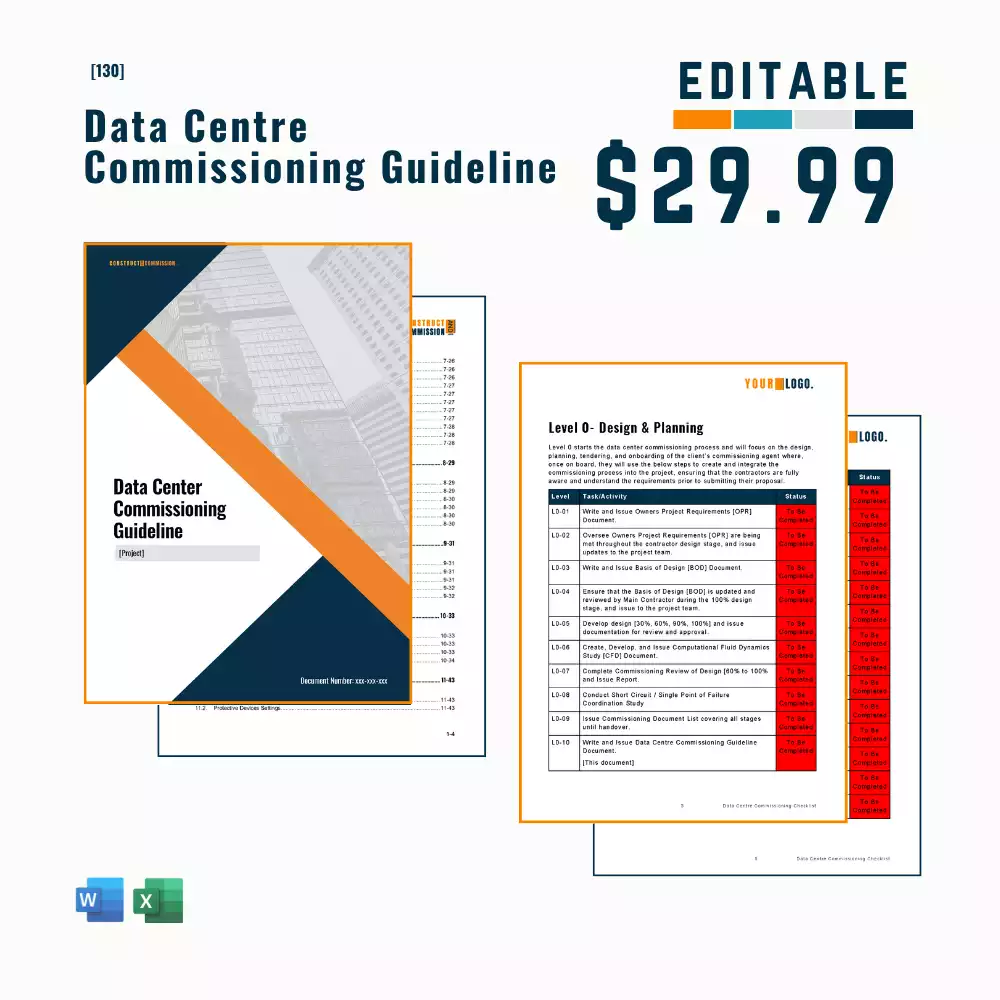
Aimed at anyone who needs a detailed delivery plan and checklist for deploying Commissioning within a Data Center Project, this document is formatted in Microsoft Word/Excel and written so that it can be deployed quickly and easily with minimal updating to suit your specific needs.
[Once through to the shop there is a sample of the document to view]
Here is our open copy [MS Word] & [MS Excel] of the Data Center Commissioning Checklist, for making life a little easier across 240 tasks and activities noting roles and responsibilities.
Get instant ⤵️ download access to the entire library of 130+ templates from Construct & Commission.
This bundle is your complete "Document-in-a-Box" solution, designed for ✅ engineers, ✅ consultants, and ✅ new companies.
Creating a comprehensive document system from scratch takes months of senior-level engineering time, slowing your ability to win clients and start projects.
This bundle provides instant, field-proven documents, allowing you to deploy a mature, professional-grade system on day one.
All 130+ 📚 documents are fully editable in MS Word and Excel.
- Accelerate Your Business: Launch your company or project in days, not months.
- Look Established: Present a professional, consistent image to every client.
- Embed Expert Knowledge: Use templates for tendering, site management, checklists (PFCs), method statements, and handover.
- Save Time: Stop creating documents and focus on billable work.
⤵️ Download the complete library to help get your system set up in hours, not weeks. ⤵️
🟩 Level 1 – Factory Testing
Level 1, managed by the General Contractor and Owners Commissioning Consultant, is where a diverse range of roles and responsibilities come together from the commissioning team to ensure that the selected plant and equipment is factory tested.
Although this stage is relatively short and uncomplicated, it necessitates the dedicated efforts of individuals with specialized tasks and expertise.
| Ref | Task / Activity | Description | CxA Responsibility |
|---|---|---|---|
| L1-01 | Provide Regular Weekly Commissioning Reports | A summarized weekly update distributed to stakeholders detailing commissioning milestones achieved, upcoming scheduled tasks, and the status of critical, unresolved issues, inline with the agreed format from Level 1. | Writes the report including vital weekly achievements, upcoming scheduled tasks, and the status of critical unresolved issues into a report for all stakeholders. |
| L1-02 | Provide Regular Monthly Commissioning Reports | A comprehensive, high-level executive summary of the monthly commissioning progress, overall budget status, major risk resolutions, and critical path timeline updates, inline with the agreed format from Level 1. | Writes the report inline with the agreed format in Level 1, including executive summary detailing monthly progress, emerging risks, and critical path master timeline updates to keep the owner informed. |
| L1-03 | Confirm dates of Factory Testing | Scheduling of dates for Factory Witness Testing (FWT) to ensure all parties are aligned before execution. | Actively coordinates with the manufacturer, contractor, and owner to finalize and formally confirm the schedule for all required factory tests. |
| L1-04 | Conduct Commissioning Meetings / Workshops and Issue Minutes | Recurring collaborative sessions held to align stakeholders, resolve issues, and track progress, documented via formal meeting minutes. | Chairs the meetings or workshops, records critical discussions, assigns action items, and promptly distributes formal minutes to all project stakeholders. |
| L1-05 | Organize Transportation and accommodation for Factory Witness Testing | The logistical planning required for travel and transport for the project team for off-site factory inspections. | Ensures that the project coordinates and arranges travel and accommodation to ensure the proecjt team can attend the factory testing. |
| L1-06 | Conduct Factory Witness Testing with Owner Team at Factory or Remotely | The physical or remote observation of equipment testing at the manufacturing facility to verify performance meets design intent before shipping. | Leads the owner's team during the FAT, directs the testing procedures, witnesses the results, and ensures the equipment strictly meets the OPR. |
| L1-07 | Add Issues and Observations to the Register / Log, ensuring to Manage to Close | The process of documenting defects, or deviations noted during testing into a centralized log. | Accurately logs all issues, assigns resolution responsibility, tracks progress, and verifies correct completion before officially closing the item. |
| L1-08 | Write Factory Witness Testing Reports | Formal documentation summarizing the testing, observed results, deviations, and overall outcome of the Factory Witness Testing. | Compiles the recorded data, analyzes performance against specifications, and authors the comprehensive final report detailing the factory testing results. |
| L1-09 | Obtain, where required, all Factory QA/QC Checklists from Factory and Log | The collection of manufacturer-completed quality assurance and quality control records verifying the equipment was built and is dispatched to proper standards. | Ensures all documentation is retrieved, reviewed, and log all mandatory factory QA/QC checklists to verify build quality before allowing site delivery. |
| L1-10 | File and Manage Commissioning Information and Records within the Project Electronic Filing System and update Commissioning Platform / Tracking | The administrative process of securely storing all commissioning documents and updating digital tracking platforms to reflect real-time project status. | Oversees and uploads all testing records, updates the centralized tracking platform, and ensures all commissioning data remains organized and accessible. |
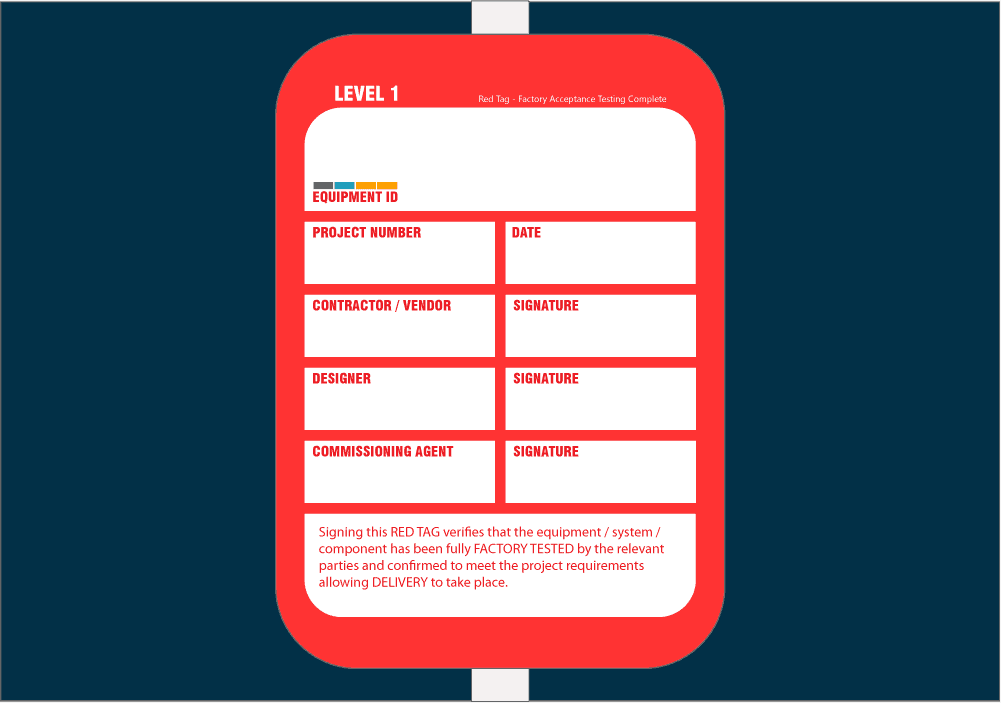
| L1-11 | Install all 'Red Tags' where applicable | The physical application of red status tags to equipment, visually denoting successful completion of Level 1 factory testing and QC checks. | Verifies testing is fully complete and ensures the physical red tags are accurately applied to the approved equipment before shipping or when arrives onsite. |
| L1-12 | Issue Confirmation to Ship Certificate | A formal authorization document explicitly allowing factory-tested and approved equipment to be transported to the construction site. | Reviews all FAT results and officially issues the authorization allowing the manufacturer to ship the critical equipment. |
| L1-13 | Ship Equipment to Site | The physical transportation and logistical delivery of approved equipment from the manufacturing facility to the final project construction site. | Monitors the shipping schedule and coordinates with the general contractor to ensure they are prepared for site delivery and future Level 2 inspections. |
| L1-14 | Issue Level 1 Sign Off Report | Confirming that all required Level 1 Factory Witness Testing (FWT) has been successfully executed, documented, and approved by the commissioning team. | Reviews detailed FAT documentation and issues official confirmation that all Level 1 testing has been successfully executed. |
🟩 Level 2 – Component Delivery, Installation & Pre-Startup
Level 2, managed by the General Contractor, is a crucial stage in the data center commissioning process, ensuring that all equipment, plant, and components are successfully delivered, installed, and thoroughly checked via pre-start-up activities to meet the project requirements.
This stage sets the foundation for the subsequent energization phase at Level 3.
| Ref | Task / Activity | Description | CxA Responsibility |
|---|---|---|---|
| L2-01 | Provide Regular Weekly Commissioning Reports | A summarized weekly update distributed to stakeholders detailing commissioning milestones achieved, upcoming scheduled tasks, and the status of critical, unresolved issues, inline with the agreed format from Level 2. | Writes the report including vital weekly achievements, upcoming scheduled tasks, and the status of critical unresolved issues into a report for all stakeholders. |
| L2-02 | Provide Regular Monthly Commissioning Reports | A comprehensive, high-level executive summary of the monthly commissioning progress, overall budget status, major risk resolutions, and critical path timeline updates, inline with the agreed format from Level 2. | Writes the report inline with the agreed format in Level 2, including executive summary detailing monthly progress, emerging risks, and critical path master timeline updates to keep the owner informed. |
| L2-03 | Issue regular 2 Week Look Ahead Schedules for Commissioning Team Resource Planning | A rolling two-week schedule detailing upcoming commissioning tasks, testing milestones, and required resources. | Reviews the schedule with contractors to ensure testing dates are accurate and required personnel are allocated effectively. |
| L2-04 | Conduct Commissioning Meetings / Workshops and Issue Minutes | Recurring sessions held to align stakeholders, resolve site issues, and track progress, documented via formal minutes. | Chairs the meetings, records critical discussions, assigns action items, and distributes formal minutes to all stakeholders. |
| L2-05 | Plan and Manage the Deliveries of Plant, Equipment, Materials | The planning and scheduling required to transport and unload project equipment at the construction site. | Monitors the delivery schedule to ensure equipment arrives safely and perfectly aligns with the project and commissioning timeline. |
| L2-06 | Complete Delivery and Storage Checklists when Plant, Equipment and Materials Arrive On Site | Use the inspection checklists created in Level 0, verifying that arriving equipment exactly matches submittals, is undamaged, and is stored correctly. | Ensure that the checklists are completed and available for the Level 2 works. |
| L2-07 | Complete Room Readiness Checklist | Verification that all necessary architectural, mechanical, and electrical prerequisites within a specific space are fully complete before equipment installation begins. | Reviews completed checklists and conducts site inspections to verify the space is fully prepared and safe for equipment installation and testing. |
| L2-08 | Complete Installation Checklist Inspections | Use the inspection checklists created in Level 0, ensuring that all equipment is physically installed correctly according to manufacturer instructions and project specifications. | Ensure that the checklists are completed and available for the Level 2 works. |
| L2-09 | Ensure all ARC Flash Stickers are attached to all Electrical Panels as per the ARC Flash Report | The physical application of mandatory warning labels detailing specific calculated arc flash hazards directly onto electrical equipment. | Physically verifies that contractors have applied the correct warning labels to electrical equipment before energization begins. |
| L2-10 | Ensure all Breakers and Setpoints are set inline with the Discrimination Study and Plant Settings Document | The process of configuring electrical breakers and operational setpoints to ensure that they align with approved project documentation. | Audits equipment to verify all software versions, setpoints, and breaker configurations are correctly and safely applied. |
| L2-11 | Conduct Initial Foreign Object Detection [FOD] Inspection for all Electrical Panels and Equipment | A physical inspection verifying that critical systems, such as electrical panels, are clear of construction debris and are clean. | Reviews checklists and inspects panels to ensure contractors have completely cleared all debris and are completely clean before testing. |
| L2-12 | Conduct Self Testing and Inspections inline with the approved Level 2 Scripts | The contractor’s internal execution of Level 2 pre-commissioning checklists to verify installation quality before offering it for witnessing. | Ensures contractors complete and accurately document their internal testing before scheduling any formal client witnessing. |
| L2-13 | Conduct Client Witnessing inline with the approved Level 2 Scripts | The formal, observed execution of Level 2 checklists to officially verify safe delivery, correct installation, and readiness for energisation and startup. | Witnesses the inspections on behalf of the client, validating the contractor's work and officially signing off the systems and equipment inline with the approved scripts. |
| L2-14 | Conduct any First of Kind [FOK] Inspections if noted in the Commissioning Plan with Client Witnessing Team | An initial, rigorous benchmark inspection of the first installed instance of a specific equipment type to set quality standards. | Witnesses the inspections on behalf of the client, validating the contractor's work and officially signing off the systems and equipment inline with the approved scripts. |
| L2-15 | Add Issues and Observations to the Register / Log, ensuring to Manage to Close | The process of documenting defects or installation deviations discovered during Level 2 into the centralized log. | Accurately logs all discovered issues, assigns resolution responsibility, and verifies correct completion before officially closing the item. |
| L2-16 | File and Manage Commissioning Information and Records within the Project Electronic Filing System and update Commissioning Platform / Tracking | The administrative process of securely storing all commissioning documents and updating digital tracking platforms to reflect real-time project status. | Oversees and uploads all testing records, updates the centralized tracking platform, and ensures all commissioning data remains organized and accessible. |
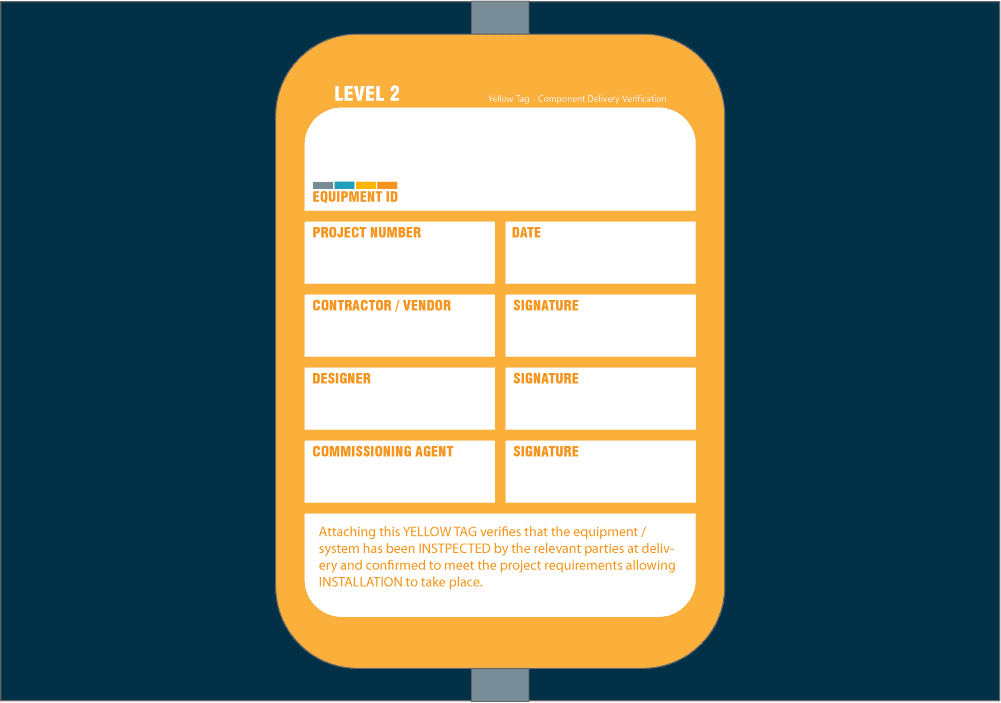
| L2-17 | Install all 'Yellow Tags' where applicable | The application of yellow status tags to equipment, visually denoting successful completion of Level 2 installation and pre-startup checks. | Verifies Level 2 is fully complete and ensures the yellow tags are accurately applied to the approved equipment. |
| L2-18 | Issue Level 2 Sign Off Report | The formal acceptance document certifying that equipment has been properly delivered, inspected, installed and is ready for startup according to all specifications. | Reviews all Level 2 documentation and issues the formal acceptance certifying that equipment is officially ready for Level 3 startup. |
🟩 Level 3 – Systems Start-Up
Level 3, managed by the General Contractor, encompasses tasks and activities to ensure that the individual plant, equipment, systems, and components are successfully started up, tested, and operating per the design intent and approved testing scripts/procedures.
This stage is crucial before combining the different systems for Level 4 and Level 5 works.
| Ref | Task / Activity | Description | CxA Responsibility |
|---|---|---|---|
| L3-01 | Conduct Daily Morning Commissioning Coordination Workshops | Daily collaborative morning briefings held to align the team on specific daily commissioning tasks, coordinate system interfaces, and review critical safety protocols. | Chairs the morning workshops, outlines the day's testing schedule, coordinates cross-trade activities, and ensures all energization safety protocols are fully understood. |
| L3-02 | Provide Daily Commissioning Reports and Updates | A daily summary, inline with the approved template create during Level 0, detailing specific start-up activities completed, roadblocks encountered, safety observations, and the updated status of critical path testing milestones. | Compiles and distributes the daily reports, highlighting completed tasks, unresolved site issues, and immediate testing priorities to keep all project stakeholders perfectly informed. |
| L3-03 | Provide Regular Weekly Commissioning Reports | A summarized weekly update distributed to stakeholders detailing commissioning milestones achieved, upcoming scheduled tasks, and the status of critical, unresolved issues, inline with the agreed format from Level 3. | Writes the report including vital weekly achievements, upcoming scheduled tasks, and the status of critical unresolved issues into a report for all stakeholders. |
| L3-04 | Provide Regular Monthly Commissioning Reports | A comprehensive, high-level executive summary of the monthly commissioning progress, overall budget status, major risk resolutions, and critical path timeline updates, inline with the agreed format from Level 3. | Writes the report inline with the agreed format in Level 3, including executive summary detailing monthly progress, emerging risks, and critical path master timeline updates to keep the owner informed. |
| L3-05 | Provide Draft Operating and Maintenance Manuals | The initial draft O&M manuals, detailing specific equipment operation and preventive maintenance instructions, provided early to support training. | Reviews the draft manuals to ensure they are formatted inline with the project requirements noted in the document approved in Level 0 works, sufficiently complete, accurate, and effectively can support initial operator training and start-up procedures. |
| L3-06 | Provide Draft Systems Manual | An initial compilation of facility design, construction, and operations documentation - including operating plans and maintenance procedures - provided early to support operator training. | Issues the draft manual to the client team for review. |
| L3-07 | Issue regular 2 Week Look Ahead Schedules for Commissioning Team Resource Planning | A rolling two-week schedule detailing upcoming commissioning tasks, testing milestones, and required resources. | Reviews the schedule with contractors to ensure testing dates are accurate and required personnel are allocated effectively. |
| L3-08 | Conduct Commissioning Meetings / Workshops and Issue Minutes | Recurring sessions held to align stakeholders, resolve site issues, and track progress, documented via formal minutes. | Chairs the meetings, records critical discussions, assigns action items, and distributes formal minutes to all stakeholders. |
| L3-09 | Install Temporary Equipment and Instruments to Facilitate the Level 3 and Level 4 works inline with the Temporary Load Bank and Equipment Plan approved during the Level 0 activities | The physical installation of artificial loads and temporary sensors / equipment required to accurately simulate operational conditions during dynamic testing. | Reviews the setup to ensure temporary equipment is installed safely and aligns with the approved testing and load bank plan. |
| L3-10 | Complete Deep Clean of Data Halls and Critical Spaces, inline with the Data Hall cleaning document approved in Level 0 activities. | The rigorous cleaning of critical IT spaces to eliminate all dust and construction debris before sensitive equipment is energized. | Inspects the critical spaces post-cleaning to formally verify that strict environmental cleanliness standards have been successfully achieved. |
| L3-11 | Ensure that the BMS and Control Logics are ready and available for Level 3 testing works | The verification that all necessary building automation / monitoring software and control logics are installed, inspected, and ready for active testing. | Ensures the system's readiness, confirming all necessary BMS / logic sequences are finalized and available for functional testing. |
| L3-12 | Ensure that the Control Room and Equipment [BMS Head End] is ready and available for testing to commence. | The physical and preparation of the control room and primary user interfaces used to monitor systems during testing. | Physically inspects the central control room to verify operator workstations and graphics are fully operational and ready to support active testing. |
| L3-13 | Plan and Manage Energization of Equipment and Systems inline with the Lock Out / Tag Out Procedure approved within Level 0 activities | The controlled, step-by-step process of introducing live power to installed equipment and systems, strictly following approved energization, life-safety and isolation protocols. | Monitors the energization schedule and verifies that all life-safety Lock Out/Tag Out procedures are followed to prevent accidents, for own engineers [Client / PM is responsible for the overall site]. |
| L3-14 | Conduct Self Testing and Inspections inline with the approved Level 3 Scripts | The contractor’s internal execution of Level 3 pre-functional start-up checklists to verify safe energization before offering systems for formal witnessing. | Ensures contractors thoroughly execute and accurately document their internal start-up testing before scheduling any formal client witnessed demonstrations. |
| L3-15 | Conduct Client Witnessing inline with the approved Level 3 Scripts | The formal, observed execution of Level 3 start-up procedures to officially verify equipment is safely energized and ready for functional testing. | Directly witnesses the start-up procedures alongside the client, strictly validating the contractor's work and officially signing off the testing scripts. |
| L3-16 | Conduct any First of Kind [FOK] Inspections if noted in the Commissioning Plan with Client Witnessing Team | An initial, rigorous benchmark inspection of the first energized instance of a specific equipment type to establish a quality standard. | Leads the FOK inspection to establish an approved operational benchmark that all subsequent identical start-ups must perfectly match. |
| L3-17 | Add Issues and Observations to the Register / Log, ensuring to Manage to Close | The continuous tracking process of documenting defects, start-up failures, or deviations discovered during Level 3 into a centralized log. | Accurately logs all discovered issues, assigns resolution responsibility, and strictly verifies correct completion before officially closing the item. |
| L3-18 | File and Manage Commissioning Information and Records within the Project Electronic Filing System and update Commissioning Platform / Tracking | The administrative process of securely storing Level 3 documentation and updating digital platforms to reflect real-time project status. | Oversees and uploads all testing records, updates the centralized tracking platform, and ensures all commissioning data remains organized and accessible. |
| L3-19 | Install all 'Green Tags' where applicable | The physical application of green status tags directly to equipment, visually denoting successful completion of Level 3 start-up and energization. | Verifies Level 3 is fully complete and ensures contractors accurately apply the physical green tags to the approved, energized equipment. |
| L3-20 | Issue Level 3 Sign Off Report | The formal acceptance document certifying that equipment has been safely energized, properly adjusted, and is officially ready for functional testing. | Reviews all Level 3 documentation and formally issues the acceptance certificate explicitly confirming readiness for Level 4 testing. |
🟩 Level 4 – Functional Performance Testing
Level 4, managed and delivered by the Owners Commissioning Consultant, with support from the General Contractor, focuses on bringing the systems together, integrating them, and conducting a series of rigorous tests to ensure their alignment with the Owner’s Project Requirements [OPR], Basis of Design [BOD], and relevant contract documentation such as drawings, specifications, and control logics.
This stage plays a pivotal role in verifying the functional performance of these integrated systems.
| Ref | Task / Activity | Description | CxA Responsibility |
|---|---|---|---|
| L4-01 | Level 4 Go / No-Go Workshop | A review meeting held prior to functional testing to confirm that all Level 3 start-up and energization activities are fully complete and systems are officially ready for Level 4 testing. | Facilitates the workshop, reviews the completion status of all prerequisites, and formally advises the project team whether to proceed with Level 4 testing. |
| L4-02 | Conduct Daily Morning Commissioning Coordination Workshops | Daily collaborative morning briefings held to align the team on specific daily commissioning tasks, coordinate system interfaces, and review critical safety protocols. | Chairs the morning workshops, outlines the day's testing schedule, coordinates cross-trade activities, and ensures all energization safety protocols are fully understood. |
| L4-03 | Provide Daily Commissioning Reports and Updates | A daily summary, inline with the approved template create during Level 0, detailing specific start-up activities completed, roadblocks encountered, safety observations, and the updated status of critical path testing milestones. | Compiles and distributes the daily reports, highlighting completed tasks, unresolved site issues, and immediate testing priorities to keep all project stakeholders perfectly informed. |
| L4-04 | Provide Regular Weekly Commissioning Reports | A summarized weekly update distributed to stakeholders detailing commissioning milestones achieved, upcoming scheduled tasks, and the status of critical, unresolved issues, inline with the agreed format from Level 3. | Writes the report including vital weekly achievements, upcoming scheduled tasks, and the status of critical unresolved issues into a report for all stakeholders. |
| L4-05 | Provide Regular Monthly Commissioning Reports | A comprehensive, high-level executive summary of the monthly commissioning progress, overall budget status, major risk resolutions, and critical path timeline updates, inline with the agreed format from Level 3. | Writes the report inline with the agreed format in Level 3, including executive summary detailing monthly progress, emerging risks, and critical path master timeline updates to keep the owner informed. |
| L4-06 | Issue regular 2 Week Look Ahead Schedules for Commissioning Team Resource Planning | A rolling two-week schedule detailing upcoming commissioning tasks, testing milestones, and required resources. | Issues the schedule to the project team to ensure testing dates are accurate and required personnel are allocated effectively. |
| L4-07 | Conduct Commissioning Meetings / Workshops and Issue Minutes | Recurring sessions held to align stakeholders, resolve site issues, and track progress, documented via formal minutes. | Chairs the meetings, records critical discussions, assigns action items, and distributes formal minutes to all stakeholders. |
| L4-08 | Ensure Temporary Equipment and Instruments to Facilitate the Level 4 works are installed inline with the Temporary Load Bank and Equipment Plan approved during the Level 0 activities | The physical installation of artificial loads and temporary sensors / equipment required to accurately simulate operational conditions during dynamic testing. | Reviews the setup to ensure temporary equipment is installed safely and aligns with the approved testing and load bank plan. |
| L4-09 | Operate Temporary Equipment and Instruments to facilitate the testing works | The active operation of temporary load banks, heaters, and sensors required to accurately simulate peak operational conditions during dynamic testing. | Monitors the operation of temporary equipment to ensure it accurately and safely simulates the required load conditions for valid testing. |
| L4-10 | Plan and Manage Functional Testing of Equipment and Systems inline with the approved Level 4 scripts | The scheduling, coordination, and step-by-step execution of functional performance tests for individual systems exactly according to the approved procedures. | Implements the testing schedule and actively directs and witnesses the execution of functional tests to verify strict OPR compliance. |
| L4-11 | Conduct Client Witnessing inline with the approved Level 4 Scripts | The formal, observed execution of Level 4 testing, officially demonstrating system capabilities directly to the client and project team. | Conducts the functional performance tests alongside the client, validating the systems operate inline with the OPR. |
| L4-12 | Complete Thermographic Studies and create report inline with the approved document in Level 0 tasks and activities | The execution of infrared thermal scanning on equipment under load to proactively detect dangerous overheating, documented in a formal report. | Analyzes the documented thermal images and reports. |
| L4-13 | Download Data, format and issue to CxA for their review and use in reports | The extraction, formatting, and formal submission of recorded performance data, trend logs, and test results from systems to the commissioning team. | Reviews and analyzes the submitted trend data to officially validate system performance before incorporating it into final reports. |
| L4-14 | Add Issues and Observations to the Register / Log, ensuring to Manage to Close | The continuous tracking process of documenting defects, start-up failures, or deviations discovered during Level 4 into a centralized log. | Accurately logs all discovered issues, assigns resolution responsibility, and strictly verifies correct completion before officially closing the item. |
| L4-15 | File and Manage Commissioning Information and Records within the Project Electronic Filing System and update Commissioning Platform / Tracking | The process of securely storing Level 4 documentation and updating digital platforms to reflect real-time project status. | Oversees and uploads all testing records, updates the centralized tracking platform, and ensures all commissioning data remains organized and accessible. |
| L4-16 | Issue Level 4 CxA Report | A comprehensive report summarizing the results, deviations, and final status of all Level 4 Functional Performance Testing for the systems. | Authors the report by compiling FPT data, documenting any unresolved issues, analyzing system performance against the design intent, and issuing formal recommendations. |
| L4-17 | Install all 'Blue Tags' where applicable | The physical application of blue status tags directly to equipment, visually denoting successful completion of Level 4 functional testing. | Verifies Level 4 is fully complete and ensures contractors accurately apply the physical blue tags to the approved, functionally tested equipment. |
| L4-18 | Issue Level 4 Sign Off Report | Formal approval certifying that all individual systems have successfully passed functional performance testing and meet the criteria of the design intent. | Witnesses critical tests and officially issues formal approval definitively certifying that individual systems have passed functional performance testing successfully and are ready for Level 5. |
Here is our open copy [MS Word] & [MS Excel] of the Data Center Commissioning Checklist, for making life a little easier across 240 tasks and activities noting roles and responsibilities.
🟩 Level 5 – Integrated Testing
The Level 5 Integrated Testing phase, managed by the Owners Commissioning Consultant, with support from the General/Main Contractor, is the final step in validating the performance of the installed systems.
It focuses on integrating all the systems, conducting rigorous tests to evaluate and verify their functionality, interoperation, and response to simulated failure scenarios, demonstrating that they operate seamlessly together, in accordance with the owner’s project requirements [OPR], Basis of Design [BOD], and other contractual documentation such as drawings, specifications, and control logics.
Once the testing has been completed, data will be collected and analyzed from the systems and instruments systems to ensure that critical data hall and other space ambient conditions are maintained during different testing scenarios.
| Ref | Task / Activity | Description | CxA Responsibility |
|---|---|---|---|
| L5-01 | Level 5 Go / No-Go Workshop | A review meeting held prior to functional testing to confirm that all Level 4 activities are fully complete and systems are officially ready for Level 5 testing. | Facilitates the workshop, reviews the completion status of all prerequisites, and formally advises the project team whether to proceed with Level 5 testing. |
| L5-02 | Conduct Daily Morning Commissioning Coordination Workshops | Daily collaborative morning briefings held to align the team on specific daily commissioning tasks, coordinate system interfaces, and review critical safety protocols. | Chairs the morning workshops, outlines the day's testing schedule, coordinates cross-trade activities, and ensures all energization safety protocols are fully understood. |
| L5-03 | Provide Daily Commissioning Reports and Updates | A daily summary, inline with the approved template create during Level 0, detailing specific start-up activities completed, roadblocks encountered, safety observations, and the updated status of critical path testing milestones. | Compiles and distributes the daily reports, highlighting completed tasks, unresolved site issues, and immediate testing priorities to keep all project stakeholders perfectly informed. |
| L5-04 | Provide Regular Weekly Commissioning Reports | A summarized weekly update distributed to stakeholders detailing commissioning milestones achieved, upcoming scheduled tasks, and the status of critical, unresolved issues, inline with the agreed format from Level 3. | Writes the report including vital weekly achievements, upcoming scheduled tasks, and the status of critical unresolved issues into a report for all stakeholders. |
| L5-05 | Provide Regular Monthly Commissioning Reports | A comprehensive, high-level executive summary of the monthly commissioning progress, overall budget status, major risk resolutions, and critical path timeline updates, inline with the agreed format from Level 3. | Writes the report inline with the agreed format in Level 3, including executive summary detailing monthly progress, emerging risks, and critical path master timeline updates to keep the owner informed. |
| L5-06 | Issue regular 2 Week Look Ahead Schedules for Commissioning Team Resource Planning | A rolling two-week schedule detailing upcoming commissioning tasks, testing milestones, and required resources. | Issues the schedule to the project team to ensure testing dates are accurate and required personnel are allocated effectively. |
| L5-07 | Conduct Commissioning Meetings / Workshops and Issue Minutes | Recurring sessions held to align stakeholders, resolve site issues, and track progress, documented via formal minutes. | Chairs the meetings, records critical discussions, assigns action items, and distributes formal minutes to all stakeholders. |
| L5-08 | Ensure Temporary Equipment and Instruments to Facilitate the Level 5 works are installed inline with the Temporary Load Bank and Equipment Plan approved during the Level 0 activities | The physical installation of artificial loads and temporary sensors / equipment required to accurately simulate operational conditions during dynamic testing. | Reviews the setup to ensure temporary equipment is installed safely and aligns with the approved testing and load bank plan. |
| L5-09 | Operate Temporary Equipment and Instruments to facilitate the testing works | The active operation of temporary load banks, heaters, and sensors required to accurately simulate peak operational conditions during dynamic testing. | Monitors the operation of temporary equipment to ensure it accurately and safely simulates the required load conditions for valid testing. |
| L5-10 | Plan and Manage Functional Testing of Equipment and Systems inline with the approved Level 5 scripts | The scheduling, coordination, and step-by-step execution of the Integrated Systems Testing in line with the approved procedures. | Implements the testing schedule and actively directs and witnesses the execution of functional tests to verify strict OPR compliance. |
| L5-11 | Conduct Client Witnessing inline with the approved Level 5 Scripts | The formal, observed execution of Level 5 testing, officially demonstrating system capabilities directly to the client and project team. | Conducts the integrated systems testing alongside the client, validating the systems operate inline with the OPR. |
| L5-12 | Download Data, format and issue to CxA for their review and use in reports | The extraction, formatting, and formal submission of recorded performance data, trend logs, and test results from systems to the commissioning team. | Reviews and analyzes the submitted trend data to officially validate system performance before incorporating it into final reports. |
| L5-13 | Remove Temporary Equipment after testing has been confirmed is complete | The physical disconnection and removal of all temporary load banks, sensors, and equipment used during Level 5 testing once all results are formally approved. | Verifies that all required testing is definitively complete and formally authorizes contractors to safely demobilize and remove temporary testing equipment from the site. |
| L5-14 | Add Issues and Observations to the Register / Log, ensuring to Manage to Close | The continuous tracking process of documenting defects, start-up failures, or deviations discovered during Level 5 into a centralized log. | Accurately logs all discovered issues, assigns resolution responsibility, and strictly verifies correct completion before officially closing the item. |
| L5-15 | File and Manage Commissioning Information and Records within the Project Electronic Filing System and update Commissioning Platform / Tracking | The process of securely storing Level 5 documentation and updating digital platforms to reflect real-time project status. | Oversees and uploads all testing records, updates the centralized tracking platform, and ensures all commissioning data remains organized and accessible. |
| L5-16 | Issue Level 5 CxA Report | The formal distribution of the finalized report detailing the outcomes, simulated failure responses, and overall facility performance during Integrated Systems Testing. | Compiles, authors, and officially issues the final IST report, formally certifying to the owner that all interacting facility systems operate cohesively and safely. |
| L5-17 | Conduct Training for Facilities Team | Completing comprehensive training sessions for the facilities team, ensuring they possess the necessary practical knowledge and skills to operate and maintain the facility effectively based on the approved documents created during the Level 0 Tasks and Activities. | Verifies that all scheduled sessions are successfully delivered, and confirms the facilities team is fully prepared to confidently assume building operations. |
| L5-18 | Issue Final Operating and Maintenance Manuals | A comprehensive series of documents detailing the specific design, mode of operation, and preventive maintenance requirements for the installed building systems. | Reviews the submitted manuals to confirm they are complete, accurate, project-specific, and fully meet the adequacy requirements outlined in the specifications before final handover. |
| L5-19 | Install all 'White Tags' where applicable | The physical application of white status tags directly to equipment, visually denoting successful completion of Level 5 testing. | Verifies Level 5 is fully complete and ensures contractors accurately apply the physical white tags to the approved, functionally tested equipment. |
| L5-20 | Issue Level 5 Sign Off Report | The formal acceptance document certifying that all facility systems have successfully passed Integrated Systems Testing (IST) and operate cohesively according to the design intent. | Reviews all IST results, verifies system interoperability under normal and failure modes, and officially issues the formal acceptance certifying Level 5 completion. |
🟩 Level 6 – Closeout/Handover
Managed and executed by the Owners Commissioning Consultant, with the support of the General Contractor, Level 6 is the final stage, where the Commissioning Process is completed with the systems transitioning to the Owner and Facilities Team, ensuring that the data center is fully prepared and optimized for operation, and all commissioning-related activities are concluded in a systematic and well-documented manner.
| Ref | Task / Activity | Description | CxA Responsibility |
|---|---|---|---|
| L6-01 | Ensure Data Halls are still clean inline with the Deep Clean that was completed in Level 3. | A final visual inspection to verify that critical IT spaces have maintained their strict environmental cleanliness standards since the initial Level 3 deep clean. | Conducts a final site walk to formally verify that the data halls remain completely free of dust and construction debris before final project handover. |
| L6-02 | Activate EMIS / FDD Systems | Energizing and setting to work the energy monitoring and fault detection software to ensure correct data collection begins. | Verifies the software is integrated with building controls, actively logging accurate data, and functioning according to design requirements. |
| L6-03 | Manage Contractor Callbacks focused on the testing and commissioning observations and issue closeout | Facilitating the resolution of post-handover testing and commissioning issues by coordinating necessary contractor returns during the initial occupancy phase. | Tracks unresolved observations, coordinates contractor callbacks for issue resolution, and verifies that corrective actions strictly meet the Owner's Project Requirements. |
| L6-04 | Conduct Final Site Walk and Inspections ensuring all Issues and Observations are closed out | A final walkthrough to verify that all commissioning observations and issues logged in the issues register are fully rectified. | Leads the final inspection, physically verifies every open issue is resolved to standard, and officially closes all observations within the centralized tracking log. |
| L6-05 | Inspect and Document all Plant Settings to ensure are in 'As Left' Condition | The systematic verification and recording of all firmware, final operational setpoints, breaker configurations, and control parameters for the installed plant and equipment. | Audits the finalized settings to ensure they strictly match the design intent, documenting them thoroughly for inclusion in the final Systems Manual. |
| L6-06 | Issue Cx Green Building Final Report | A report documenting the project's adherence to the commissioning tasks and activities related to the green building goals. | Writes the document clearly showing the goal that have been achieved and issues to the client team and Green Building Consultant. |
| L6-07 | Issue EMIS / FDD Review and Reports | Formal reports evaluating the energy management and fault detection systems, ensuring they accurately collect data, execute diagnostic algorithms, and generate actionable performance insights. | Analyzes system data, verifies diagnostic algorithms trigger correctly under fault conditions, and issues final reports confirming the platform meets the owner’s efficiency tracking goals. |
| L6-08 | Complete any Remedial Works and System Optimizations inline with the EMIS / FDD Review and Reports | Executing necessary repairs and system fine-tuning based on fault data generated by the diagnostic software to resolve performance problems. | Verifies that the remedial works and optimizations successfully resolve identified faults, improve system efficiency, and ensure continued compliance with the Owner's Project Requirements. |
| L6-09 | Issue Final Systems Manual | A complete, finalized reference guide delivered to the facilities team, detailing exactly how to safely maintain, operate, and troubleshoot the facility, its equipment and systems. | Writes and formally issues to the client and facilities team for their review and use, once approved. |
| L6-10 | Commissioning Final Report | A comprehensive report summarizing all completed testing results, the final resolution of issues, and a holistic evaluation of the final system performance and attach all Cx Documents. | Write the document summarizing all completed testing results, final issue resolutions, and ultimate final system performance, then attach all commissioning information and data. |
| L6-11 | File and Manage All Final Commissioning Information and Records within the Project Electronic Filing System and update Commissioning Platform / Tracking | The process of securely storing Level 5 documentation and updating digital platforms to reflect real-time project status. | Oversees and uploads all testing records, updates the centralized tracking platform, and ensures all commissioning data remains organized and accessible. |
| L6-12 | Issue Commissioning Lessons Learned Meeting Agenda | A structured outline for the post-project debrief, specifically aimed at identifying project successes, failures, and actionable areas for improvement on future builds. | Writes the post-project debrief to explicitly identify project successes, failures, and actionable areas for improvement on future builds. |
| L6-13 | Conduct Lessons Learned Workshop and Minute | A collaborative review session held post-completion to evaluate the overall commissioning process, identifying project successes, challenges, and actionable areas for improvement. | Organizes and leads the workshop with key stakeholders, records valuable insights, and distributes formal minutes detailing specific recommendations for future project enhancements. |
| L6-14 | Handover Report | The formal transition document officially transferring control, operation, and ongoing responsibility of the fully commissioned systems from the project team to the facilities management team. | Writes the document, then issues to the client team, noting that all equipment, systems, observations and documents are complete and can be handed over to the facilities team. |
| L6-15 | Conduct Cx Closeout / Ready for Service Meeting | A final meeting held with key stakeholders to review the overall commissioning process, discuss final results, and formally obtain necessary project approvals. | Chairs the closeout meeting, presents the final commissioning results, addresses any remaining open items, and officially secures formal acceptance from the owner. |
| L6-16 | Issue End of Warranty / 10-month Review Report | A formal post-occupancy assessment conducted near the warranty expiration / 10-months to identify failing components, unresolved issues, or performance deviations for warranty claims and contractor / vendor call backs. | Leads the site review with O&M staff, documents defective items, and issues a formal report recommending necessary contractor warranty repairs. |
| L6-17 | Issue Scripts for Seasonal and Deferred Testing | Developing specific test procedures to evaluate system performance under actual peak seasonal weather or delayed full-load conditions. | Authors and distributes targeted test scripts, ensuring they accurately reflect the necessary conditions for deferred and seasonal performance verification. |
| L6-18 | Conduct Seasonal and Deferred Testing | Executing deferred tests during appropriate peak heating, cooling, or intermediate seasons to verify systems operate correctly under all weather conditions. | Directs and witnesses the seasonal testing with operations staff, resolving any identified performance issues during these specific environmental conditions. |
| L6-19 | Update All Reports and Handover Documents inline with the Seasonal and Deferred Testing | Modifying the Systems Manual, final Commissioning Report, and issues log to incorporate the new data and results gathered from seasonal testing. | Compiles final seasonal test data, updates all relevant handover documentation, and submits the finalized records to the owner for acceptance. |
⬜ Data Center Commissioning Checklist [Downloads]
Below we have included our Excel & MS Word Data Center Commissioning Checklists that can be viewed and purchased from our shop by clicking the button below. You will receive each type of checklist [.doc] & [.xls] shown within the purchase.
⬜ Data Center Commissioning Checklist [MS Word]
⬛ Related Articles
⬛ Latest Articles
TEST PACKS | Understanding the Process for Building Commissioning
A test pack or final test pack is a comprehensive document used during the construction…
[HLT] DATA HALL HEAT LOAD TESTING | A Guide
The fundamental purpose of a Heat Load Test [HLT] is to thoroughly test a data…
TESTING vs COMMISSIONING | What is the Difference?
While both testing and commissioning are essential to ensuring building systems function correctly and efficiently,…
DATA CENTER | Commissioning Guideline & Template
DATA CENTER COMMISSIONING | What is it?
TIER V Platinum Data Center | What is it?
Created by ‘Switch,’ a Tier 5 Platinum Standard design enhances some of the more traditional…